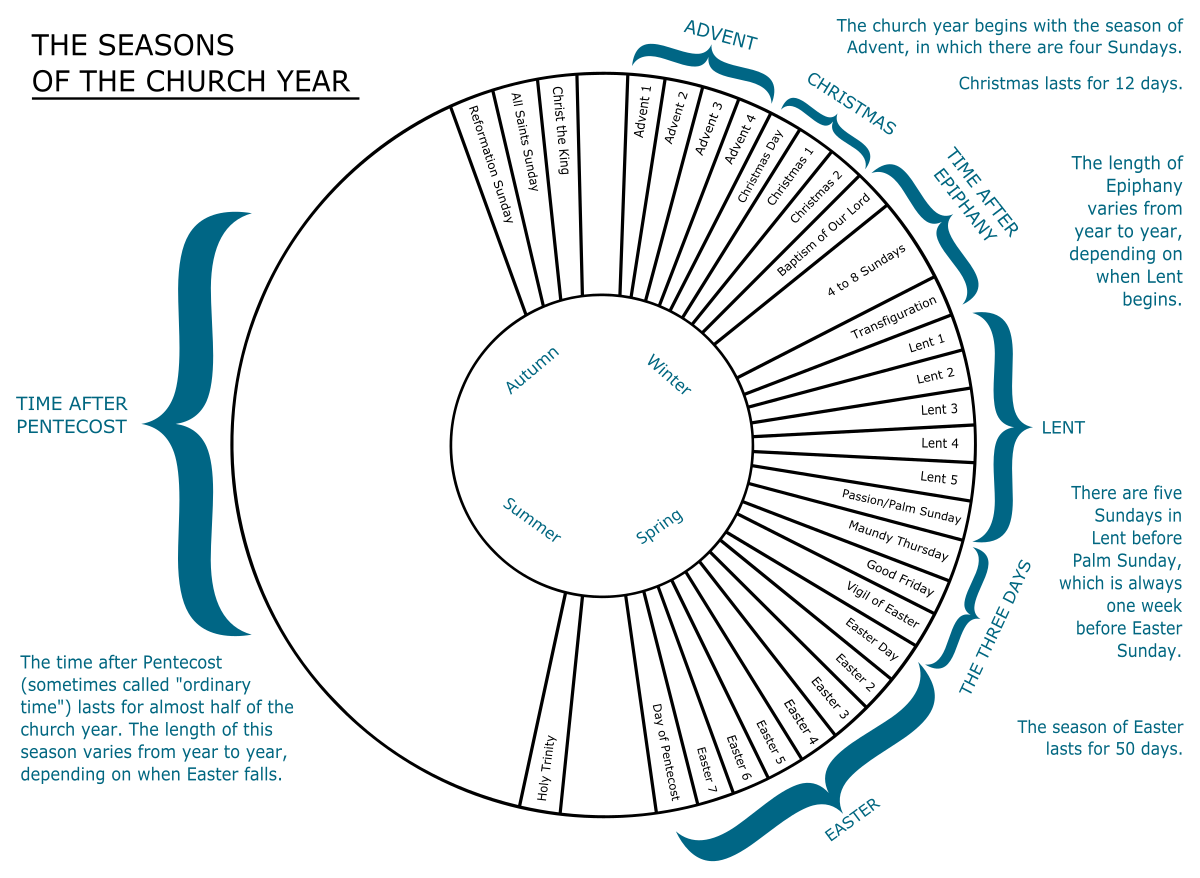
Diagram from Wikimedia Commons (accessed September 2025).
The ‘liturgical cycle’ divides the Christian year into a series of seasons, each with its own mood, theological emphasis, and modes of prayer. Each can be signified by different ways of decorating the church, choice of pulpit falls, scriptural readings and themes for preaching.
A simple guide to the liturgical year is provided by BBC bitesize. (Some details included do not apply in the Protestant tradition.)
In churches that choose to follow the liturgical year, the scripture passages for each Sunday are given in a ‘lectionary’. The details of the lectionary are available on the Church of Scotland website, plus a guide to the Christian seasons.
The Greenbank minister determines the form of public worship, and may choose to follow the lectionary at his or her discretion.
The Christian year at Greenbank includes the following seasons:
Advent and Christmas
Advent, which means ‘coming’ or ‘arrival’, is a season of preparation and anticipation in the four weeks leading up to Christmas. It marks the beginning of the liturgical year and focuses on waiting for the birth of Jesus.
The season of Christmas begins on the 25th December and traditionally lasts twelve days, ending on 5th January. Christmas is the time when Christians celebrate the birth of Jesus.
Epiphany and Lent
Christmas is followed by the season of Epiphany, which begins on 6th January. Epiphany celebrates the revelation of God in human form through Jesus Christ, highlighting events like the visit of the Magi, the baptism of Jesus, and the miracle at Cana.
Epiphany is followed by the season of Lent, which is the Christian season of preparation for Easter. It is observed over 46 days (40 days excluding Sundays) leading up to Easter Sunday. It is a time for reflection, repentance, and self-examination.
The first day of Lent is known as ‘Ash Wednesday’, and, as indicated, takes place 46 days before Easter Sunday. Since Easter is a movable holiday – see below – Ash Wednesday moves with it. The season of Epiphany can last from 4 to 9 weeks.
Holy Week comprises the seven days at the end of Lent leading up to Easter Sunday. These days are: Palm Sunday, Holy Monday, Holy Tuesday, Holy Wednesday, Maundy Thursday, Good Friday, and Holy Saturday. Each day commemorates specific events in the final week of Jesus’ life.
Easter
Easter Sunday is the first Sunday after the full Moon that occurs on or after the Spring Equinox. Easter Sunday marks the beginning of the Easter season, which lasts for fifty days, ending with Pentecost Sunday.
The central theme of Easter is the Resurrection of Jesus and the hope of eternal life. It is a time of joyful celebration.
Specific Days
- Ascension: The fortieth day of Easter commemorates the Ascension of Jesus.
- Pentecost: The fiftieth day marks the coming of the Holy Spirit upon the disciples, and concludes the Easter season.
Harvest
The tradition of giving thanks for the harvest has biblical roots, with ancient Israelites and early Christians acknowledging the importance of agricultural seasons and the bounty of God’s provision.
Harvest Festival celebrations in the Church of Scotland are joyful, community-focused events that give thanks to God for the provision of food and the blessings of creation. They typically include:
- Thanksgiving Worship Service
- Decorations
- Churches are adorned with fruit, vegetables, bread, and flowers, often arranged around the pulpit or communion table.
- Sometimes, schoolchildren or local farmers contribute produce.
- Food Donations
- Congregations bring non-perishable food items for local food banks (e.g., the Trussell Trust) or charities.
- Some churches organize a “harvest supper” or shared meal after the service.
- Community Outreach
- Emphasis on sharing with the needy—donations go to shelters, elderly groups, or international aid (e.g., Christian Aid).
- Schools linked to the church may hold their own harvest assemblies.
- Practical and Reflective
- Focuses on thankfulness and social action.
- May include prayers for farmers and climate justice.
The harvest thanksgiving festival is usually held in September or October, aligning with the traditional Scottish harvest season. Greenbank’s Harvest Thanksgiving service is normally held on the first Sunday in October.
Remembrance
Remembrance in the Church of Scotland involves commemorating the sacrifices of armed forces personnel, past and present, through services and acts of remembrance. These events, often held on or around Remembrance Sunday and Armistice Day, include prayers, readings, and reflections on themes of peace, reconciliation, and the ongoing impact of conflict. The Church of Scotland also participates in national and local ceremonies, working with organizations like Poppyscotland to honour those who have served.
Armistice Day is on 11th November. Remembrance Sunday takes place on the closest Sunday to the 11th. For example, in 2024 Remembrance Sunday was on 10th November.
Greenbank’s Celebration of the Church Seasons
Details of the seasonal events and how we mark these at Greenbank are described here: